

How to Learn Robotics for Beginners?
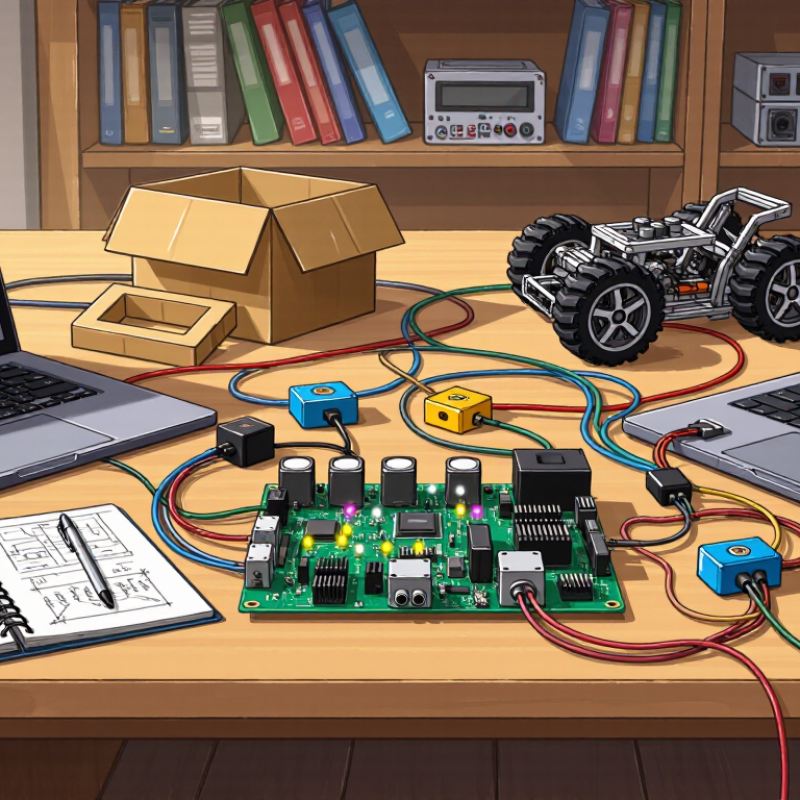
Learning robotics can feel intimidating when motors, sensors, code, and mathematics appear together. The path becomes clearer when beginners start with small, testable projects. A blinking LED can lead to a distance sensor. A distance sensor can guide a two-wheel robot around a cardboard box. These simple experiments build practical confidence.
Rodney Brooks, a roboticist, MIT professor emeritus, and iRobot co-founder, once said, “The robots are coming, and they are going to change the world.” His observation gives this subject real urgency. Yet beginners should not rush toward expensive humanoid robots. They need strong foundations in programming, electronics, mechanics, and problem-solving. This guide explains how to learn robotics through a gradual, evidence-based process. It covers beginner-friendly tools, essential concepts, project ideas, and common mistakes. Reliable documentation matters. Safety matters more. Always check battery ratings, moving parts, and manufacturer instructions before testing hardware.
Start with a programmable board, a small motor driver, and inexpensive sensors. Keep a notebook. Record the wiring, code changes, and unexpected behavior. My first robot would probably turn too late, stall, or follow the wrong object. That failure is useful. It reveals gaps in measurement or design. Beginners should reflect instead of hiding imperfect results. They should also compare tutorials with official technical sources and reputable courses. Robotics rewards patience, careful observation, and repeated testing. You may not understand every equation immediately. That is normal. Progress often begins with one successful movement.
What Robotics Is and Why Beginners Study It
Robotics is the study of machines that sense, decide, and act in the physical world. A robot may use cameras, motors, sensors, and software together. It can sort objects, follow a line, or hold a steady position. The International Federation of Robotics reported 541,302 industrial robot installations worldwide in 2023. Its World Robotics 2024 report also recorded more than four million industrial robots operating globally. These figures show why beginners study robotics: automation is becoming a practical engineering skill, not a distant science-fiction idea.
Learning robotics connects several subjects at once. Beginners meet basic mechanics when choosing gears and wheel sizes. They use mathematics to calculate distance, speed, and battery use. Programming gives the machine instructions, while electronics helps control motors and read sensors. A small practice task can be concrete. Place a light sensor above a white card. Then move it toward a dark line. The robot may twitch. That is normal.
The World Economic Forum’s Future of Jobs Report 2023 identified robotics and automation as major workplace changes through 2027. It also projected 69 million new roles and 83 million displaced roles worldwide. The numbers do not guarantee a job. They do suggest that people who understand machines may adapt more easily. Beginners should expect wrong wiring, unstable code, and weak mechanical designs. A failed test can reveal more than a perfect demonstration. Still, technical confidence grows slowly, through careful measurements and repeated repairs.
How to Learn Robotics for Beginners? - What Robotics Is and Why Beginners Study It
| Learning Area | What It Means in Robotics | Core Concepts to Learn | Beginner Practice Activity | Expected Beginner Outcome | Typical Study Time | Difficulty |
|---|---|---|---|---|---|---|
| Robotics Fundamentals | Understanding how robots sense their surroundings, process information, and produce movement. | Robot types, autonomy, degrees of freedom, actuators, sensors, controllers, and feedback. | Draw a block diagram showing the relationship between sensors, a controller, actuators, and the environment. | Explain the basic operation of a robot and distinguish hardware from software components. | 1–2 weeks | Beginner |
| Basic Mathematics | Mathematics provides the language used to describe position, orientation, motion, and control. | Algebra, geometry, trigonometry, vectors, coordinate systems, and introductory matrices. | Calculate the position of a point using two-dimensional coordinates and basic trigonometry. | Read simple robot diagrams and perform basic position and distance calculations. | 2–4 weeks | Beginner |
| Programming | Programming defines how a robot interprets sensor data and decides what action to take. | Variables, conditions, loops, functions, data structures, debugging, and basic numerical computation. | Write a simulation that changes a robot’s movement when an obstacle is detected. | Create readable programs using logic, reusable functions, and simple sensor-based decisions. | 3–6 weeks | Beginner |
| Electronics | Electronics allows a robot’s controller to communicate with sensors, motors, and power systems. | Voltage, current, resistance, circuits, digital signals, analog signals, and electrical safety. | Build a low-voltage circuit that reads a light or distance sensor and activates an indicator. | Understand simple circuits and connect input and output devices safely. | 2–4 weeks | Beginner |
| Sensors | Sensors provide measurements that help a robot estimate its environment and internal state. | Distance, light, touch, temperature, inertial measurement, encoders, noise, and calibration. | Compare repeated sensor readings and calculate a simple average to reduce random variation. | Choose a suitable sensor for a basic task and recognize the importance of calibration. | 2–3 weeks | Beginner |
| Actuators and Motion | Actuators convert electrical energy into physical movement. | DC motors, servomotors, stepper motors, torque, speed, gearing, wheels, and mechanical limits. | Model how changing motor speed affects the movement of a two-wheel mobile robot. | Relate motor choice and control signals to the robot’s speed, direction, and load. | 2–4 weeks | Beginner |
| Control Systems | Control systems help a robot reach and maintain a desired position, speed, or direction. | Open-loop control, closed-loop control, error, feedback, proportional control, and stability. | Use a simple proportional rule to reduce the difference between a target value and a measured value. | Explain why feedback generally improves accuracy compared with commands without measurement. | 3–5 weeks | Intermediate |
| Kinematics | Kinematics describes motion without focusing on the forces that cause it. | Position, velocity, acceleration, coordinate frames, forward kinematics, and inverse kinematics. | Calculate the end position of a simple two-joint arm using link lengths and joint angles. | Understand how joint movements affect the position of a robot’s end point. | 3–6 weeks | Intermediate |
| Robot Software Architecture | Software architecture organizes communication between sensing, planning, control, and actuation. | Modular design, message passing, timing, state machines, logging, and error handling. | Design a state machine with idle, search, move, avoid, and stop states. | Break a robotics project into manageable modules instead of writing one large program. | 2–4 weeks | Intermediate |
| Navigation and Planning | Navigation enables a robot to select and follow a route toward a goal. | Maps, waypoints, obstacle avoidance, grid representations, path cost, and basic search methods. | Plan a route through a grid while avoiding blocked cells and minimizing unnecessary movement. | Describe the difference between deciding where to go and controlling how to get there. | 3–6 weeks | Intermediate |
| Computer Vision and AI | Vision and machine learning can help robots identify objects, people, or visual patterns. | Images, pixels, edges, classification, training data, model accuracy, and limitations. | Use a small set of labeled images to distinguish between two simple visual categories. | Understand that AI is one part of robotics and depends on data, sensors, and reliable decision logic. | 4–8 weeks | Intermediate |
| Safety and Responsible Design | Robot systems must be designed to reduce risks to people, equipment, and the environment. | Emergency stops, current limits, safe motion, testing procedures, privacy, and human supervision. | Create a checklist for power-off procedures, moving-part hazards, and safe testing distances. | Identify common risks and apply safe practices before operating a physical robot. | 1–2 weeks | Beginner |
Note: Study times are practical planning estimates for a beginner studying several hours per week. Actual progress depends on prior knowledge, project complexity, and hands-on practice.
Related Posts
-
How to Learn Robotics for Beginners?
-
Why You Should Learn Robotics for Future Career Opportunities?
-
China Top 10 Robotic Solutions Revolutionizing Industries Today?
-

Top Robotic Tools That Are Revolutionizing Industries Today?
-
How to Use Han's Robot for Your Home Automation Needs?
-
Top 10 Benefits of Using an Automatic Tool Changer Robot in Manufacturing